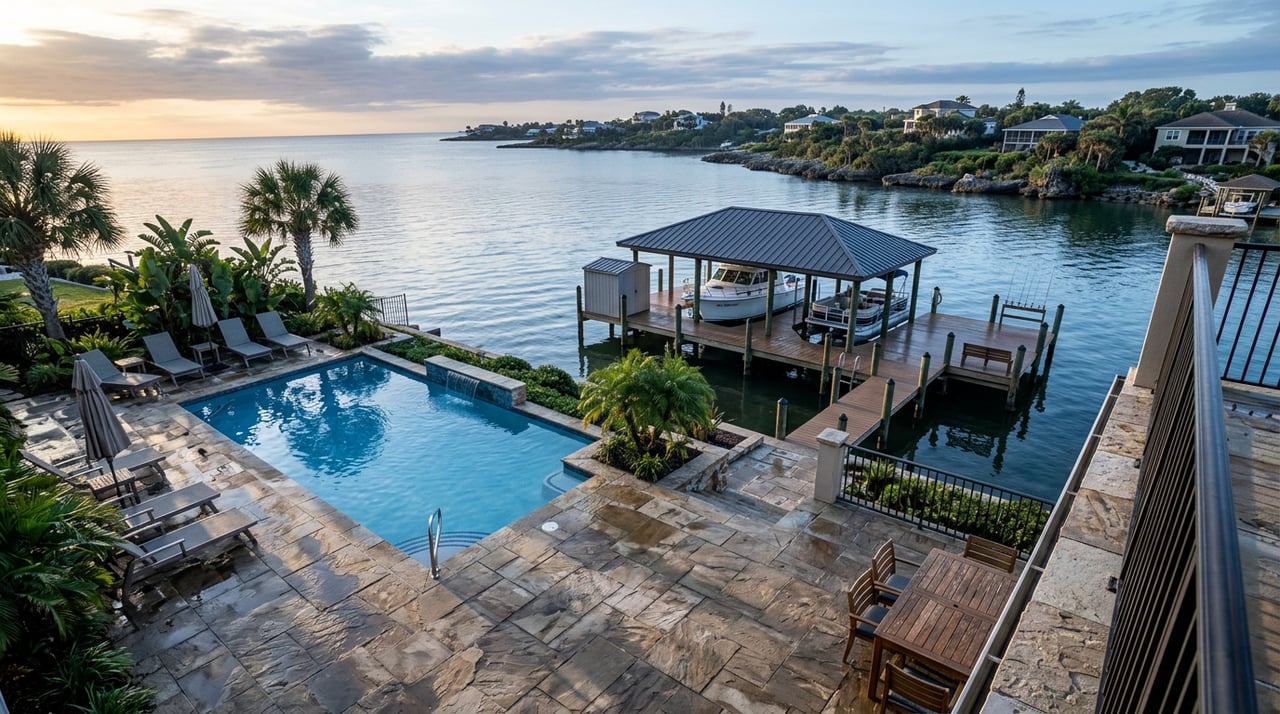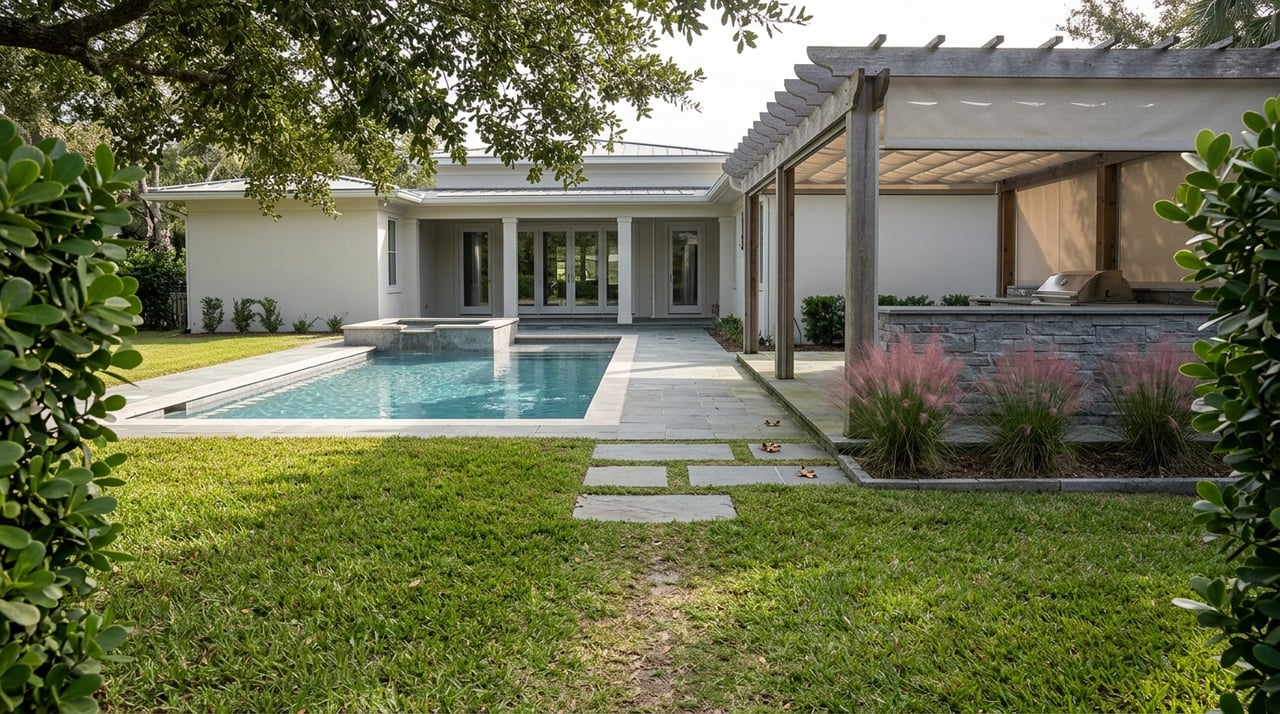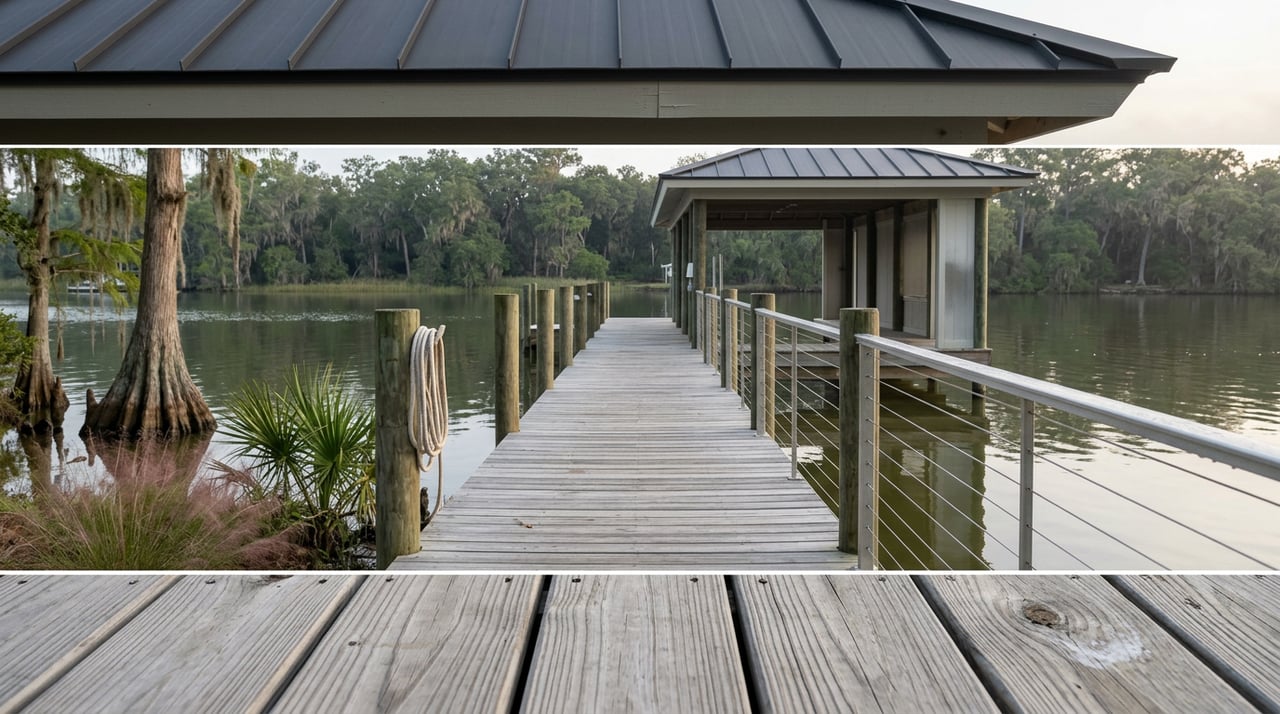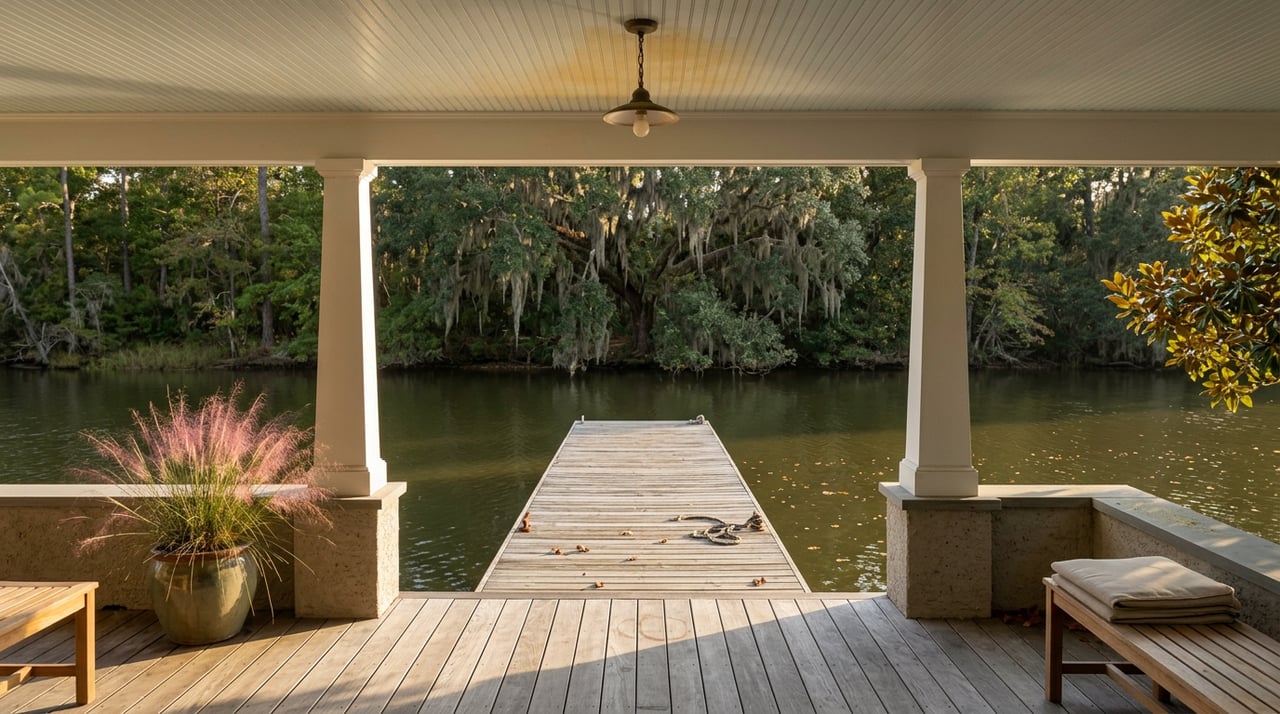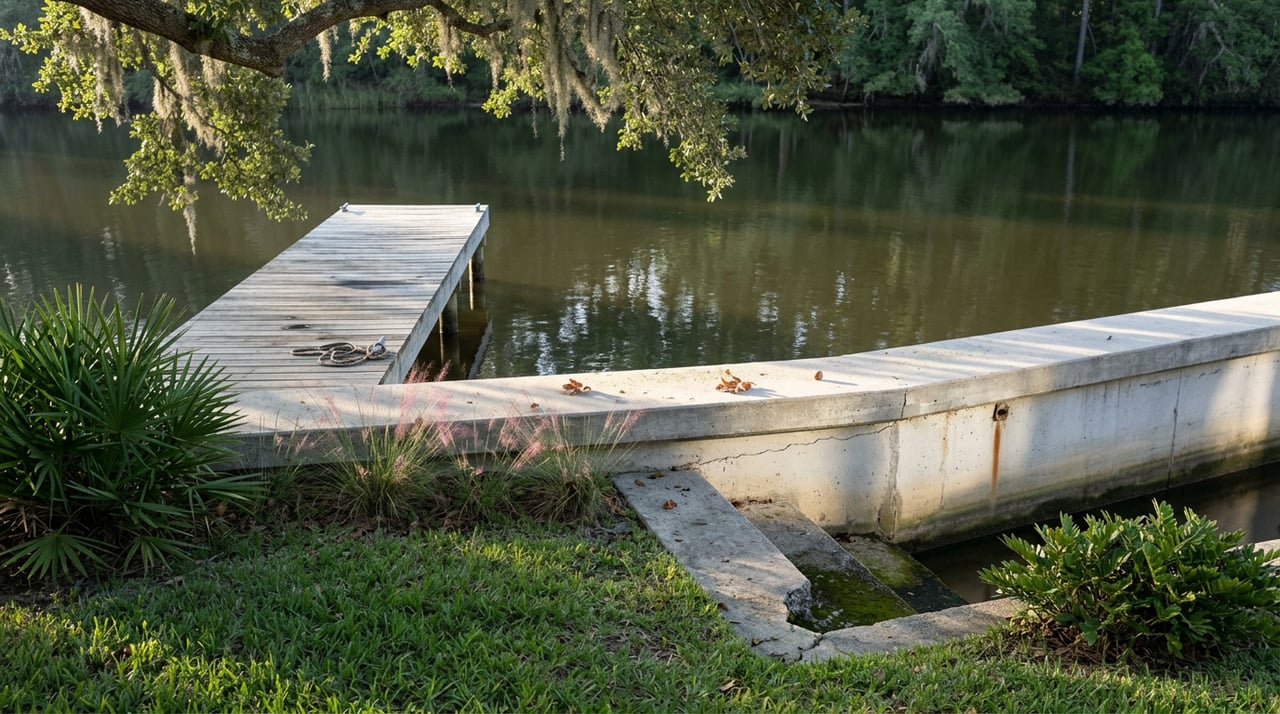
Walk Bunkers Cove Road toward the water on a quiet morning and the neighborhood does exactly what it's supposed to do. Live oaks lean over the street, a dock sits low against the bayou, and a seventy-year-old bungalow looks as settled and permanent as it did the day it was built. Nothing about the scene suggests paperwork.
That's the problem. The wall holding that yard back from Massalina Bayou, Watson Bayou, or St. Andrews Bay itself is usually the same age as the house behind it, sometimes older. In 2026, it's the file on that wall, not its physical condition, that's most likely to stall a Cove closing.
A Neighborhood Built Before Anyone Thought About Permits
The Cove earned its "Little New York" nickname when wealthy northern transplants arrived by yacht through the St. Andrews Bay Yacht Club and built homes on narrow lots close to the water. Most of what's still standing came later: small wood-frame bungalows from the 1950s and 1960s, the same construction wave that gives the neighborhood its oak-lined, old-Florida character today.
Seawalls don't get the same charm treatment. According to cost-tracking site HomeGuide, a concrete seawall typically lasts 30 to 50 years, steel closer to 25 to 35, and vinyl 50 to 60. Run that math against a bungalow built in 1958 and its original seawall, assuming it's still the original, has been past its expected life for a decade or more. Some owners have already replaced or reinforced theirs. Plenty haven't, and some who have don't have a permit on file to prove it.
The Two Numbers Reshaping Every Waterfront Quote in Bay County
Two things happened on the insurance side of this equation, and neither has anything to do with the condition of any single seawall. Both change how closely a lender or carrier will look at yours.
First, Bay County redrew its flood maps in October 2024, the first update since 2009, according to Lynn Haven-based Kirkland Insurance Agency. A property that sat comfortably outside a flood zone under the old map can carry an AE or A designation now, and Bay County treats Zone A, the zone along the water, as the first area considered for evacuation.
Second, Citizens Property Insurance is leaving Bay County fast. The state's insurer of last resort held 6,502 personal residential policies in the county at the end of 2024, representing $1.87 billion in exposure. By June 30, 2026, that had fallen to 1,796 policies and $400 million, a drop of roughly 72 percent in eighteen months, based on Citizens' own county-level reporting. Private carriers are picking up the difference, and private carriers underwrite more carefully than a state backstop ever needed to. That means more requests for documentation on anything that isn't visible from the street, docks and seawalls included.
| 2026 Shift | Effective | What It Changes for a Cove Seller or Buyer |
|---|---|---|
| Statewide wind mitigation form (OIR-B1-1802) rewritten by Florida's Office of Insurance Regulation | New form required starting April 1, 2026 | Older reports may still be honored, but carriers started pricing against the new form in July 2026 |
| Bay County FEMA flood map update | First revision since 2009, effective October 2024 | Some Cove properties changed flood zones without their owners doing anything differently |
| Citizens Property Insurance exit from Bay County | Policy count down roughly 72% between December 2024 and June 2026 | Private carriers now underwrite most Bay County waterfront homes and ask harder questions about permitted work |
None of these three shifts is really about the seawall. All three change who's asking about it and how closely.
What Bay County's Permit File Actually Shows
Bay County requires a permit for new construction or a structural repair to a dock or seawall, and the county keeps those records searchable by address through its online permitting portal. That search is the single most useful five minutes a buyer or seller can spend before an offer gets written, because it answers a question a standard home inspection can't.
A general home inspector isn't the right person to evaluate a seawall in the first place. That work calls for a certified seawall or bulkhead specialist or a marine engineer, someone trained to read hydrostatic pressure, weep holes, and tie-back corrosion rather than roof flashing and outlet grounding.
Panama City's own waterfront infrastructure makes the point. When crews rebuilt the St. Andrews Marina, part of a bulkhead repair project the city approved at nearly $13 million, they found sheet piles driven in the 1950s that needed structural injection to seal decades-old joints before the rest of the work could proceed, according to a case study from Prime Resins. If the city's own marina needed that kind of intervention on infrastructure from that era, a private homeowner's wall from the same decade deserves the same scrutiny, and a call to a locally established marine contractor. Summit Marine Development, led by Jose Morales, has handled seawall and dock permitting and construction across Panama City and the Florida Panhandle for more than a decade, the kind of licensed team that can pull the history, not just quote the repair.
The Cost of Finding Out at the Closing Table
Seawall repair runs $100 to $250 per linear foot, and a full replacement typically lands between $150 and $600 per linear foot, or $15,000 to $60,000 for an average residential project, according to HomeGuide's cost data. On a narrow, historic Cove lot, that range is real money to discover for the first time during an inspection period, especially when the discovery isn't the wall's condition but the absence of any permit showing it was ever legally repaired at all.
That gap matters more this year because a lender or insurer who might have waved it through in 2023 now has a private carrier's underwriting file asking for it directly.
What This Means If You're Buying or Selling in The Cove Right Now
- If you're buying, request the Bay County permit history for the dock and seawall before you write an offer, not after your inspector flags a question neither of you can answer.
- If you're selling, pull your own permit file before you list. A missing permit becomes a negotiating point the moment a buyer's insurance agent asks for it, and it's cheaper to solve on your timeline than on theirs.
- Schedule any wind mitigation inspection under the post-April 2026 OIR-B1-1802 form rather than an older version, since carriers started pricing against the new form in July 2026, according to tracking from Hurricane Safety Program.
- Check your flood zone against Bay County's 2024 map, not whatever zone applied under the 2009 version, before you assume this year's insurance quote will match last year's.
FAQ
Does Florida require sellers to disclose seawall permit problems? Florida Statute 689.302 requires sellers to disclose whether a property has had a flood insurance claim or received federal flood assistance, a requirement tracked by outlets like NerdWallet. That's narrower than seawall permit history specifically, which is exactly why pulling the county file yourself, before a buyer's agent asks, is worth doing regardless of what disclosure law strictly requires.
Is a wind mitigation inspection the same as my home inspection? No. A standard home inspection covers the property broadly, and a 4-point inspection focuses on roof, electrical, plumbing, and HVAC. A wind mitigation inspection is a separate, state-standardized report using form OIR-B1-1802 that documents specific wind-resistant features insurers are required to credit, and the current version of that form is valid for up to five years according to Florida's Office of Insurance Regulation.
Should I worry that Citizens is leaving Bay County? Not necessarily. It generally signals that private insurers see the county as a market worth competing for again. The practical effect for a Cove waterfront owner is a more detailed underwriting process, not a worse one, and that process rewards a property with clean permit records.
Talk Through Your Cove Property Before You List or Write an Offer
Whether you're weighing a bungalow on Bunkers Cove or getting ready to list one, the seawall's paper trail deserves the same attention as the curb appeal. The Sostheim Group spends its days in exactly this kind of Panama City waterfront due diligence, and we're glad to help you pull the right records before you're standing at a closing table wishing you had. Contact Us.